


Myostatin Inhibitor Research: Why the Most Promising Trial in This Field Was Stopped by Nosebleeds
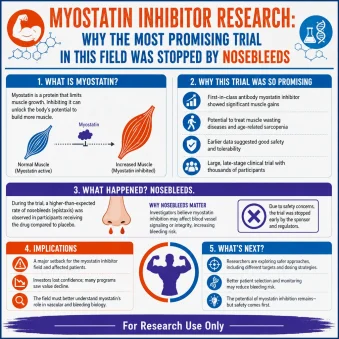
On 21 April 2011 the Duchenne muscular dystrophy trials of ACE-031 were halted. The reason was not muscle toxicity or liver enzymes or anything you would predict from a drug aimed at muscle growth. It was nosebleeds and small dilated blood vessels under the skin. Working out why a myostatin inhibitor damaged blood vessels is the most instructive thing in this entire field, and I have not found a single supplier page that explains it.
Research-use-only disclaimer: Compounds discussed are supplied for in-vitro and laboratory research use only and are not intended for human or veterinary use in that context. Clinical trial results below concern investigational drug products administered under medical supervision. No dosing, administration or performance guidance appears in this article, and nothing here is medical advice or a treatment claim for muscular dystrophy, sarcopenia, cachexia or any other condition.

TL;DR
Myostatin, or GDF-8, is a TGF-beta family protein that limits muscle growth, and knocking it out produces the famous double-muscled cattle. Two strategies exist for blocking it. A decoy receptor like ACE-031 is soluble ActRIIB fused to an antibody fragment; a ligand trap like follistatin binds myostatin itself. The decoy approach failed in a way that teaches the whole field a lesson: ActRIIB also binds BMP9 and BMP10, which drive ALK1 signalling that keeps blood vessels stable, so the trial produced nosebleeds and telangiectasia and was halted on 21 April 2011. Those two signs are the cardinal features of a genetic ALK1 disorder. The drug reproduced a hereditary disease. Research use only.
Myostatin (GDF-8): TGF-beta family, negative regulator of muscle mass.
Receptor: ActRIIB, which also binds activins, BMP9 and BMP10.
Decoy receptor: ACE-031, soluble ActRIIB-Fc. Halted 21 April 2011.
Why: epistaxis and telangiectasia, from loss of BMP9 and BMP10 signalling.
Ligand trap: follistatin binds myostatin and activin A directly.
The recurring result: muscle mass increases, function often does not.
Status: research use only, nothing approved.
Myostatin Is a Brake, Not an Accelerator
Most growth signalling works by pushing. Myostatin works by holding back.
Myostatin, formally growth differentiation factor 8 or GDF-8, is a member of the transforming growth factor beta superfamily. It is produced mainly by skeletal muscle, and its function is to limit skeletal muscle mass. Remove it and muscle grows.
That inversion matters for how you read everything else about this pathway. A myostatin inhibitor is not adding a growth signal. It is releasing an existing restraint, which means the effect depends on how much restraint was there to begin with.
Signalling runs through activin receptor type IIB, usually written ActRIIB, a serine-threonine kinase receptor that pairs with a type I receptor and phosphorylates SMAD proteins, which then move to the nucleus and change transcription.
Hold on to the receptor name. Almost everything that went wrong in this field went wrong because of what else binds it.
The Natural Experiments
The pathway was found the way a lot of good biology gets found, by noticing animals that looked strange.
Belgian Blue and Piedmontese cattle carry loss-of-function mutations in the myostatin gene and are described as double-muscled. The phenotype is dramatic and it was recognised by breeders long before anyone knew the gene existed.
Whippets carrying one copy of a myostatin mutation are faster racers. Carrying two copies produces the heavily muscled dogs breeders call bully whippets, which is a nice demonstration that the effect is dose-dependent at the gene level.
And in 2004 a case report described a child in Germany with a myostatin loss-of-function mutation and marked muscle hypertrophy from birth.[1]
Those observations are what made the pathway attractive as a drug target, and the logic was reasonable: if losing myostatin produces more muscle across three species including humans, blocking it pharmacologically should do the same.
Two Ways to Block It, and They Are Not Equivalent
Almost every discussion of this field treats myostatin inhibitors as one category. There are two mechanisms and the difference is where the failures come from.
Block the receptor. Build a soluble version of ActRIIB, fuse it to an antibody Fc fragment so it lasts in circulation, and release it as a decoy. Ligands bind the decoy instead of the real receptor on muscle. ACE-031 works this way.[2]
Trap the ligand. Use a protein that binds myostatin directly and prevents it reaching any receptor. Follistatin works this way.
Those sound like two routes to the same place. They are not, and the reason is a question of what each approach catches by accident.
A decoy receptor catches everything the receptor binds. If ActRIIB accepts six ligands, a soluble ActRIIB decoy will sequester all six in proportion to their affinity. You are not blocking myostatin, you are blocking the receptor's entire input.
A ligand trap catches what the trap binds. Narrower in principle. But follistatin is not a myostatin-specific reagent either; it is primarily an activin antagonist that also binds myostatin, so it has its own off-target list.
Neither approach is selective for myostatin alone. The field has never had a genuinely selective tool of the kind the marketing implies, and I think that fact explains most of the history that follows.
What Happened to ACE-031
ACE-031, later called ramatercept, is a fusion protein of the extracellular domain of ActRIIB and an IgG1 Fc region. It was developed by Acceleron Pharma, later partnered with Shire, and taken into Duchenne muscular dystrophy, which was a sensible indication: a disease of progressive muscle loss, a mechanism that increases muscle mass, and a population with a large unmet need.[2]
A randomised, placebo-controlled trial in ambulatory boys with Duchenne began, and the results were eventually published in 2017.[3]
On 21 April 2011, Acceleron and Shire announced that the trials had been halted. The study was stopped after the second dosing regimen because of epistaxis and telangiectasia.[2][4]
Nosebleeds and dilated small blood vessels.
Development was discontinued in May 2013.[2]
Read those two adverse events again and notice what they are not. They are not muscle problems. They are not liver enzymes, kidney function, or any of the things you would list in advance as risks for a drug targeting the muscle growth pathway. They are vascular events, and the vasculature was not supposed to be involved at all.
Why Nosebleeds, Specifically
Here is the answer, and it is entirely contained in the receptor name I asked you to remember.
ActRIIB does not bind only myostatin. Among its other high-affinity ligands are BMP9 and BMP10, bone morphogenetic proteins 9 and 10.
BMP9 and BMP10 are the primary activators of ALK1 signalling in vascular endothelium. ALK1, activin receptor-like kinase 1, is a type I receptor whose job in blood vessels is maintaining endothelial quiescence: keeping endothelial cells in a stable, non-proliferating, structurally sound state.[5]
So the chain is short and it is unavoidable once you see it. A soluble ActRIIB decoy released into circulation sequesters whatever ActRIIB binds. That includes BMP9 and BMP10. Less BMP9 and BMP10 reaching endothelium means less ALK1 signalling. Less ALK1 signalling means endothelial cells lose quiescence, and vessel walls become fragile and abnormally dilated.
Fragile dilated vessels in the nasal mucosa bleed. Fragile dilated vessels in the skin are visible as telangiectasia.
The Genetic Disease It Reproduced
This is the part I find genuinely remarkable and it is why I wanted to write this article.
There is an inherited human disorder caused by loss-of-function mutations in ALK1, encoded by the gene ACVRL1, and in endoglin, its co-receptor. It is called hereditary haemorrhagic telangiectasia, also known as Osler-Weber-Rendu syndrome.
Its two cardinal clinical features are recurrent epistaxis and mucocutaneous telangiectasia.
Recurrent nosebleeds and dilated small vessels. The same two things that stopped the ACE-031 trial.
ACE-031 blocked ALK1 signalling pharmacologically, by removing the ligands that activate it, and the result was a phenocopy of the genetic disease caused by removing ALK1 itself. Different point of attack on the same pathway, same clinical picture.
I want to be careful about the strength of this claim, because it would be easy to overstate. I am describing a mechanistic correspondence between an adverse event profile and a known genetic syndrome, and the reasoning is: BMP9 and BMP10 activate ALK1, ACE-031 sequesters BMP9 and BMP10, ALK1 loss-of-function causes HHT, and ACE-031 produced the two signs that define HHT. Each link in that chain is documented. I have not seen a paper that states the whole chain in one place, and if that paper exists I would like to read it.
What the correspondence gives you is a way to reason forward rather than backward. Anyone building a new ActRIIB-directed molecule now has a specific prediction to test: does it spare BMP9 and BMP10 binding? That is a measurable property, and it is the property the next generation of these compounds has been designed around.
Follistatin, and a Different Set of Problems
Follistatin takes the other route and inherits a different set of difficulties. The compound-specific detail lives in our follistatin reference, so this section covers only where it sits in the pathway.
Follistatin binds ligands rather than mimicking a receptor. Its principal native role is antagonising activin A, and it also binds myostatin, which is what brought it into this field.
That makes it narrower than an ActRIIB decoy in one direction, since it does not sit in front of everything the receptor accepts, and it does not appear to produce the BMP9 and BMP10 problem. It is broader in another direction, because activin A has extensive biology of its own across reproduction, inflammation and tissue remodelling, and a compound whose day job is blocking activin A is not a clean myostatin tool either.
The two commonly discussed forms, follistatin 344 and follistatin 315, are splice variants. The 344 form carries a heparin-binding domain that 315 lacks, so 344 associates with cell surfaces and extracellular matrix while 315 circulates more freely. That is a difference in where each acts rather than what it binds, and it matters more for distribution than for selectivity.
What the Field Did Next
The interesting part of this story is not that ACE-031 failed. It is what people built once they understood why.
Two responses, pulling in opposite directions.
Keep targeting the receptor, but use an antibody. Bimagrumab is a monoclonal antibody against activin type II receptors, so it blocks the receptor rather than acting as a soluble decoy that circulates and sequesters ligands. That is a different pharmacology with a different distribution, and it has been carried much further in the clinic than ACE-031 managed.[7]
Or narrow the target radically. Apitegromab, originally SRK-015, does something cleverer. Myostatin is produced as an inactive precursor that must be proteolytically activated, and apitegromab binds the latent form specifically, blocking activation rather than blocking mature myostatin or its receptor.[8]
That design choice is a direct answer to the ACE-031 problem. Because it does not touch active myostatin and does not sit at the receptor, it does not interfere with the related factors that a broad blockade catches, which is the reason conventional inhibitors have run into effects on bone formation and vascular health.[8]
Apitegromab has been through the Phase 2 TOPAZ study in spinal muscular atrophy types 2 and 3, with results published in Neurology, and has progressed to regulatory review.[8]
Neither compound is anything you will find in a research chemical catalogue, mine included. They are monoclonal antibodies developed under GMP by pharmaceutical companies. I include them because they are what the science actually did after 2011, and any account of this field that stops at ACE-031 and follistatin is fifteen years out of date.
The Unexpected Second Act
Bimagrumab's Phase 2 result did something nobody planned, and it repositioned the entire class.
The trial ran 48 weeks in adults with type 2 diabetes and obesity. At the end, total body fat mass fell 20.5 percent while lean mass rose 3.6 percent, against placebo figures of a 0.5 percent fat reduction and a 0.8 percent lean mass loss. Total weight loss exceeded 7 percent.[7]
Read those two numbers together. Fat down by a fifth, muscle up. That is a body composition change rather than a weight loss result, and it is not what a drug built to treat muscle wasting was supposed to produce.
The reason this matters now rather than in 2021 is what happened to obesity medicine in between. GLP-1 and multi-receptor agonists now routinely produce 20 to 30 percent total weight loss, as covered in the retatrutide comparison, and a well-known problem with losses of that size is that a meaningful fraction of the tissue lost is lean rather than fat.
Which creates an obvious pairing, and somebody ran it. A randomised Phase 2 of bimagrumab plus semaglutide, alone and in combination, was published in Nature Medicine, reporting weight loss with muscle mass preserved.[9]
So the ActRII pathway found its use as an adjunct that changes the composition of GLP-1-driven weight loss rather than as a muscle-building drug in its own right. I did not see that coming and I doubt Acceleron did either in 2011.
Mass Without Function
The recurring result across this entire field, and the one that should temper any enthusiasm, is that these compounds reliably increase muscle mass and much less reliably increase what people can do with it.
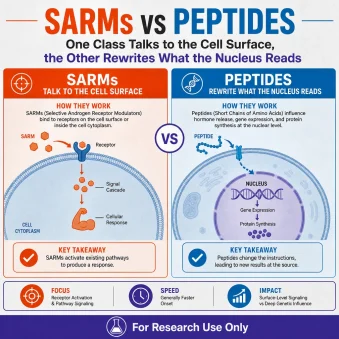
That pattern is not unique to myostatin inhibitors. It also showed up on the SARM side, where enobosarm met a lean body mass endpoint and missed physical function, as covered in the SARMs and peptides comparison. Two unrelated mechanisms, same dissociation.
There are several possible explanations and I do not know which is right. Added muscle may be added without proportional increases in the neural drive, tendon capacity or mitochondrial density needed to use it. The functional tests chosen may be insensitive over the trial durations used. Or muscle mass may simply be a weaker determinant of function than the field assumed when it picked mass as the endpoint.
What I would take from it is narrower and more useful than picking a winner among those. Mass is a proxy endpoint and this field has repeatedly discovered that the proxy does not carry. Any claim about a myostatin-directed compound that rests on cross-sectional area or lean mass has not established the thing people actually care about, and the trials that went looking for the second thing have mostly not found it.
Why It Works Better in Disease Than in Health
Back to the framing from the top of the article, because it pays off here and it explains the clinical pattern better than anything else I can offer.
Myostatin is a brake. An inhibitor does not add a growth signal, it releases an existing restraint. So the size of the effect depends on how much restraint was there to release.
In conditions where myostatin signalling is elevated, and muscle is being actively held back or broken down, there is a lot of brake to take off. That describes cachexia, disuse atrophy, and several muscular dystrophies. It is not a coincidence that the indications this class has been taken into are all diseases of muscle loss.
In a healthy, well-nourished, trained individual, the brake is presumably being applied less hard, because muscle is not being actively wasted. Releasing a restraint that was not restraining much should produce a smaller effect.
I hold this as a hypothesis rather than a documented finding, and I want to be clear that I have not seen a study designed to test it directly by comparing myostatin blockade in a wasting population against a healthy one under matched conditions. It is the reading that makes the most sense of a class that repeatedly underperformed expectations built on knockout phenotypes.
It also explains why the knockout animals mislead. Belgian Blue cattle never had the brake at all, through development, while the muscle was being built. That is a different intervention from removing a brake in an adult whose muscle mass has already been set, and the two should not be expected to produce the same result.
Side by Side
| Decoy receptor (ACE-031) | Ligand trap (follistatin) | |
|---|---|---|
| What it is | Soluble ActRIIB fused to IgG1 Fc | Natural binding protein |
| Blocks at | The receptor | The ligand |
| Catches by accident | Everything ActRIIB binds | Activin A and relatives |
| BMP9 and BMP10 sequestered | Yes | Not by this route |
| Vascular adverse events | Yes, trial-stopping | Not reported by this mechanism |
| Clinical status | Discontinued May 2013 | No approved product |
What Research Has Not Established
No myostatin-directed compound has been approved for human use for any indication. Several have entered clinical development and none has come out the other side.
Whether increasing muscle mass by this route improves function in any population is unresolved, and the trials that have tested it have mostly not shown it.
No published work that I have found states the full BMP9, BMP10, ALK1 and hereditary haemorrhagic telangiectasia chain as one explanation for the ACE-031 adverse events, although every link in it is documented separately. I have set it out as reasoning rather than as a citation, and it should be read that way.
Nothing in the clinical literature describes research-grade material. Every result discussed here was produced with drug product manufactured under GMP for a registered trial.
What is well established: that myostatin is a negative regulator of muscle mass, that the loss-of-function phenotypes exist across species including one human case report, that ACE-031 is a soluble ActRIIB-Fc fusion, that its trials were halted on 21 April 2011 for epistaxis and telangiectasia, that development stopped in May 2013, and that BMP9 and BMP10 are high-affinity ActRIIB ligands driving ALK1 signalling in endothelium. Those are checkable.
How These Are Characterised
These compounds sit at the awkward end of what a peptide supplier handles, and the analytical requirements differ from a short synthetic peptide.
Follistatin and ActRIIB-Fc constructs are recombinant proteins, not solid-phase synthesis products. They are produced in expression systems, they carry glycosylation that varies with the host cell line, and they fold into defined tertiary structures that are required for activity.
Two consequences follow. Reversed-phase HPLC purity means less here than for a fifteen-residue peptide, because a correctly-sequenced protein that has misfolded can look identical on that assay and be inactive. And size-exclusion chromatography matters more, because it detects the aggregates that recombinant proteins form readily and that a reversed-phase method can miss.
If a certificate for a recombinant protein reports only reversed-phase purity, it has answered a question about composition and not about whether the material is folded.
At PrymaLab, research compounds are characterised with HPLC and mass spectrometry verification and independent third-party testing.
Frequently Asked Questions
What is myostatin?
GDF-8, a TGF-beta superfamily protein that limits skeletal muscle mass. Loss-of-function variants produce marked muscle hypertrophy across several species.
How do myostatin inhibitors work?
Two ways. A decoy receptor like ACE-031 is soluble ActRIIB that mops up ligands before they reach the real receptor. A ligand trap like follistatin binds myostatin directly. The decoy catches everything the receptor binds.
Why was the ACE-031 trial stopped?
Acceleron and Shire halted the Duchenne trials on 21 April 2011 after the second dosing regimen because of epistaxis and telangiectasia. Development was discontinued in May 2013.
What caused the vascular side effects?
ActRIIB also binds BMP9 and BMP10, which activate ALK1 signalling that maintains endothelial quiescence. A soluble ActRIIB decoy sequestered them, so vessels became fragile and dilated.
Is there a genetic disease that looks like the ACE-031 side effects?
Hereditary haemorrhagic telangiectasia, caused by ALK1 and endoglin mutations, whose cardinal features are recurrent nosebleeds and telangiectasia. The drug phenocopied it from a different point on the same pathway.
How is follistatin different from a decoy receptor?
It binds ligands rather than mimicking a receptor. Its main native role is antagonising activin A, so it has a different off-target list and does not produce the BMP9 and BMP10 problem.
What is the difference between follistatin 344 and 315?
Splice variants. The 344 form has a heparin-binding domain that 315 lacks, so 344 sticks to cell surfaces and matrix while 315 circulates. A difference in where they act rather than what they bind.
How did the field solve the selectivity problem?
By moving upstream. Apitegromab binds the latent, inactive precursor of myostatin and blocks its activation, rather than blocking mature myostatin or the receptor. Because it never touches the receptor, it does not sequester the related factors that a broad blockade catches.
Why is a myostatin drug being tested with semaglutide?
Because bimagrumab's Phase 2 in type 2 diabetes and obesity produced a 20.5 percent fat mass reduction with a 3.6 percent lean mass increase at 48 weeks. GLP-1 drugs now produce very large weight losses of which a meaningful fraction is lean tissue, so a randomised Phase 2 of bimagrumab plus semaglutide tested whether the combination preserves muscle. The class found its use as a body composition adjunct.
Is myostatin inhibition approved for anything?
No. Nothing in this class is approved, and the field has a long record of increasing muscle mass without improving function.
References
- Schuelke M, et al. Myostatin mutation associated with gross muscle hypertrophy in a child. N Engl J Med. 2004.
- ACE-031 (ramatercept) development history, including the 21 April 2011 halt announced by Acceleron Pharma and Shire and the May 2013 discontinuation. Muscular Dystrophy Association coverage: MDA Quest
- Campbell C, et al. Myostatin inhibitor ACE-031 treatment of ambulatory boys with Duchenne muscular dystrophy: results of a randomized, placebo-controlled clinical trial. Muscle Nerve. 2017. Wiley
- Single ascending-dose study of ACE-031 in healthy volunteers.
- BMP9 and BMP10 as high-affinity ActRIIB ligands and primary activators of ALK1 signalling maintaining endothelial quiescence.
- Hereditary haemorrhagic telangiectasia: ACVRL1 (ALK1) and endoglin mutations, epistaxis and mucocutaneous telangiectasia as cardinal features.
- Effect of bimagrumab vs placebo on body fat mass among adults with type 2 diabetes and obesity: a phase 2 randomized clinical trial. JAMA Netw Open. 2021. JAMA Network Open. Source for the 20.5 percent fat mass and 3.6 percent lean mass figures at 48 weeks.
- Apitegromab as a selective inhibitor of latent myostatin, and the Phase 2 TOPAZ study in spinal muscular atrophy types 2 and 3. Neurology and PubMed 38330285
- Bimagrumab plus semaglutide alone or in combination for the treatment of obesity: a randomized phase 2 trial. Nat Med. Nature Medicine
The mechanistic chain linking ACE-031's adverse events to ALK1 signalling is assembled from separately documented findings and is presented as reasoning rather than as a single cited conclusion. Verify each link before relying on it. Status current as of 19 August 2026.
Final disclaimer: This article is an educational research reference. Compounds discussed are sold and studied for laboratory research use only and are not approved by any regulatory authority for human or veterinary use. Statements have not been evaluated by the FDA. Nothing here is medical advice, administration guidance, performance guidance, or a treatment claim for Duchenne muscular dystrophy, sarcopenia, cachexia or any other condition.
Clinical trial results described above relate to investigational drug products administered under medical supervision and do not describe or support any use of research-grade material. The safety events described led to the discontinuation of a clinical programme. Always verify the legal status of any research compound in your jurisdiction before purchase or use.